


Education
Tianjin University develops 1st emergency transport ECMO system in China
exploringtianjin.com
Updated:2022-07-27


A few days ago, a sudden critical patient in Zhangjiakou, Hebei was successfully treated with the first domestic Extracorporeal Membrane Oxygenation, developed by Tianjin University. It is also known as the "artificial heart-lung machine".
This is a "milestone moment" on the first clinical application of ECMO, and it will become a model for the clinical translation of the "integration of medicine and engineering" at Tianjin University.
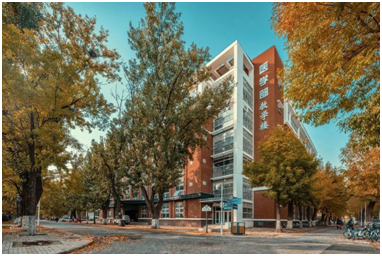
Medical College of Tianjin University [Photo provided to chinadaily.com.cn]
The full name of ECMO is Extracorporeal Membrane Oxygenation, that is, "artificial heart-lung machine", and it is known as the "king" of the existing cardiopulmonary bypass.
The principle is to use the blood pump to replace the heart, and the membrane lung to replace the lung. That way, the blood is continuously transported to the human body, forming an extracorporeal life cyclesystem to ensure the continuous functioning of various organs to maintain life.
As the most advanced technology in critical care, ECMO has become an important indicator to measure the comprehensive rescue level of critical patients in a hospital, a region or even a country.
At present, the main manufacturers of ECMO have been dominated by American and German companies for a long time.
There are only about 500 machines in China, which are basically foreign imports.

An emergency transport extracorporeal membrane oxygenation machine jointly developed by the Institute of Disaster and Emergency Medicine of Tianjin University and Tianjin Welcome Medical Equipment Co., Ltd. [Photo provided to chinadaily.com.cn]
Institute of Disaster and Emergency Medicine of Medical College of Tianjin University, and Tianjin Welcome Medical Equipment Co., Ltd. jointly developed the emergency transport extracorporeal membrane oxygenation (ECMO) system.
This type of ECMO has the advantages of small size, portability, simple operation and stable performance.
In addition, it is suitable for various complex scenes from natural disasters, such as on-site first aid, safe transfer of critically injured patients, and pre-hospital care, especially for diseases such as severe heart and lung failure, cardiac arrest, and severe cardiopulmonary and other chest trauma at the disaster site.
Approved by the hospital’s ethics committee, it has been promoted in top hospitals, including Tianjin University Chest Hospital, Tianjin Medical University General Hospital, and the First Affiliated Hospital of Zhengzhou University.
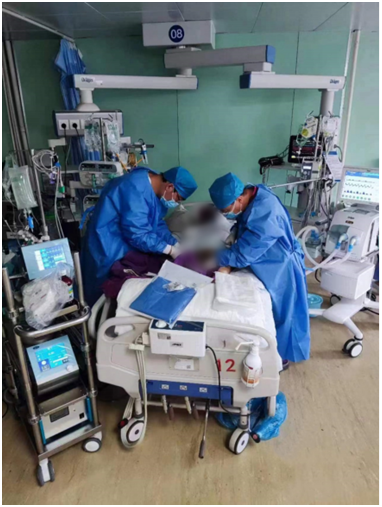
Physicians are treating a critical patient with the emergency ECMO system. [Photo provided to chinadaily.com.cn]
On July 22, a critical patient was admitted to the emergency department of the First Affiliated Hospital of Hebei Northern Institute in Zhangjiakou City.
The patient was admitted to the hospital in the agonal state with extremely unstable vital signs.
After consultation by the expert group and informed consent, the hospital decided to use extracorporeal cardio pulmonary resuscitation technology, based on the domestic emergency ECMO system, to implement venous-arterial (V-A) support to assist circulatory respiratory function
With the meticulous efforts, the medical staff successfully completed the catheterization and transfer on the patient.
After 12 hours, the patient gradually became conscious, and the vasoactive drugs were gradually reduced.
In addition, bedside ultrasound showed that the cardiac function has recovered.
Physicians successfully implemented the weaning after gradually reducing the flow of ECMO support. As of the time of publication, the patient's vital signs are stable and no complications occurred.
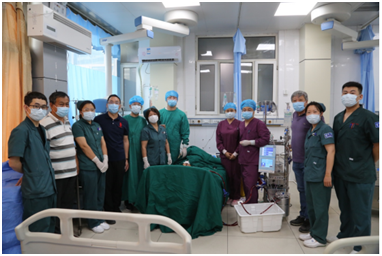
A moment establishing the ECMO assistance. [Photo provided to chinadaily.com.cn]
Xue Qianlong, director of the emergency department of the First Affiliated Hospital of Hebei Northern Institute, was in charge of this first aid.
He said the current international ECMO products are expensive, and they are difficult to get during the pandemic; the emergency ECMO developed by Tianjin University is easy to operate. Its performance is comparable to that of foreign mainstream products, and the cost is less than half of similar products.
Fan Haojun, deputy dean of the Institute of Disaster and Emergency Medicine of the Medical College of Tianjin University, led the team that comprehensively analyzed the system and compared it to the pros and cons of foreign products.
Combined with the actual domestic emergency clinical needs, they focused on the core technology equipment to carry out independent research and development, such as blood pump, membrane lung, Heparin Coatingand circuit of the ECMO system.
The developers are expected to break the monopoly of foreign products in this field, and achieve a major breakthrough in the independent research and development of domestic high-end ECMO.




Copyright 1995 - . All rights reserved. The content (including but not limited to text, photo, multimedia information, etc) published in this site belongs to China Daily Information Co (CDIC). Without written authorization from CDIC, such content shall not be republished or used in any form. Note: Browsers with 1024*768 or higher resolution are suggested for this site.
Registration Number: 130349
- follow us

