


Education
Tianjin University team converts battery waste into efficient catalysts
exploringtianjin.com
Updated:2021-09-13


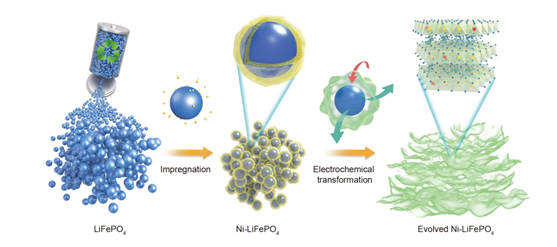
A research team at Tianjin University led by Professors Hu Wenbin and Chen Yannan successfully converted spent cathode material (LiFePO4) into high-performance electrocatalysts to use in oxygen evolution reactions (OER) through a simple impregnation method via in situ electrochemical transformations.
Lithium-ion batteries (LIBs) are a widely-used power source for portable electronics and electric vehicles due to their high energy and power density. It is likely that large amounts of battery waste will pose a threat to the environment in the future. Consequently, it is important to find a way to recycle LIB materials in an efficient and environmentally friendly manner.
The Fe element contained in the spent cathode materials is an important metal mineral resource and is widely used in industrial catalysis as the main component of many catalysts.
Based on this, the team tried to convert spent LiFePO4 into nanocatalysts with high activity. By introducing Ni to activating inert Fe sites in battery waste, the team obtained NiFe oxy/hydroxide nanosheets catalysts with high activity.
During the catalytic reaction, the near-spherical LiFePO4 particles spontaneously transform into ultra-thin nanosheets, which provides open space for boosting the process. Moreover, Ni and Fe synergistically reduce the required energy for electrocatalytic reactions and further enhance their catalytic activity.
These nanosheet catalysts overcome the shortcomings of LiFePO4 particles in battery waste, including large area, limited specific surface area and low activity, and show excellent catalytic activity and stability superior to that of noble metal catalysts in catalytic performance tests.
This research will allow manufacturers to substitute expensive noble metal catalysts with low-cost battery waste. Considering its low material wastage, short production period, high yield and ease of scaling, the research results have great industrial value, cost advantages and market potential. The low-cost and efficient recycling of battery waste will also contribute to energy saving and emission reduction efforts.
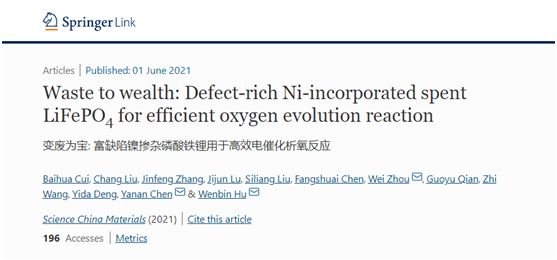
The research was published in Science China Materials with the title Waste to wealth: Defect-rich Ni-incorporated spent LiFePO4 for efficient oxygen evolution reaction.




Copyright 1995 - . All rights reserved. The content (including but not limited to text, photo, multimedia information, etc) published in this site belongs to China Daily Information Co (CDIC). Without written authorization from CDIC, such content shall not be republished or used in any form. Note: Browsers with 1024*768 or higher resolution are suggested for this site.
Registration Number: 130349
- follow us

