


Education
Bio-inspired robot developed to be a space “catcher”
exploringtianjin.com
Updated:2021-02-04


Tianjin University has developed a novel continuum bio-inspired robot that looks like a flexible arm, which - if it passes ongoing ground tests - will serve as a “catcher” in space to handle failed satellites and space debris.
The research, by Kang Rongjie, an Associate Professor from the leading university's Centre for Advanced Mechanisms and Robotics, has been published in The International Journal of Robotics Research under the title of “Geometric constraint-based modeling and analysis of a novel continuum robot with shape memory alloy initiated variable stiffness”.
Inspired by biological tentacles and snakes, soft continuum robots possess theoretically infinite degrees of freedom (DOFs), intrinsic compliance, and high adaptability. They can avoid obstacles and explore unknown environments without the assistance of complex sensors, thus extending the capabilities of traditional rigid robots that only work within specified space.
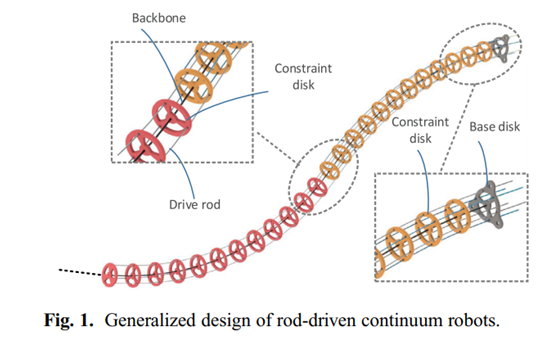
The newly-developed novel continuum robot by Kang’s research group is composed of a central backbone made of hyper elastic NiTi alloy and constraint disks created using 3D printing. The drive rods evenly distributed around the constraint disks can actively control the prototype to curve or passively deform it within changing environments. When it comes to blind spots, the robot can observe the object through a camera installed at its end, steer clear of obstacles and catch its target.
To enhance the load capacity of the flexible arm, the research group has also designed a variable stiffness mechanism powered by a set of embedded Shape Memory Alloy (SMA) springs. When the robot arrives at a predetermined operating position, the drive rods and constraint disks can be relatively locked, so that the robot’s stiffness can be tripled at most, achieving conversion from softness to stiffness.
Additionally, Kang’s research group has initiated a geometric constraint-based modeling theory to calculate the large-scale deformation of the high-redundancy flexible manipulator, which enables the coupling control of both strength and position and reveals the multiple bending mechanism of the continuum robot that traditional models can’t explain. This modeling theory may be applied to structural optimization and control algorithm development for the robot.
Dai Jiansheng, one of the co-authors of the research paper, who is an IEEE and ASME fellow and the editor-In-chief of journal Robotica, said that this research could also be applied to disaster rescue, aero-engine maintenance and other uses.




Copyright 1995 - . All rights reserved. The content (including but not limited to text, photo, multimedia information, etc) published in this site belongs to China Daily Information Co (CDIC). Without written authorization from CDIC, such content shall not be republished or used in any form. Note: Browsers with 1024*768 or higher resolution are suggested for this site.
Registration Number: 130349
- follow us

